Aquarium Stocking Calculator
What is the Stocking Calculator?
This calculator finds the first limiting factor (bioload, oxygen, or space) and uses that as your recommendation. It accounts for fish mass, waste production, surface area for oxygen exchange, and filtration capacity.
How it works: We calculate multiple constraints (bioload from volume, oxygen from surface area) and take the minimum. Recommended is where most stable tanks live long-term.
How to Use This Calculator
- Choose your input method: enter dimensions (length × width × height) OR just enter volume (gallons/liters)
- If using dimensions: select your tank shape (rectangular, cylinder, bowfront, etc.)
- Enter your measurements or select a common tank size
- Choose your fish archetype (affects mass, waste, and activity)
- Select your filtration level and tank maturity
- Enter the adult size of your fish (not current size!)
- See stability-based recommendations: high, moderate, and low stability levels
What's your tank shape?
How would you like to enter your tank info?
Enter Your Tank Dimensions
Fish Type
Note: Different fish types produce different amounts of waste (bioload). Goldfish and deep-bodied fish need much more space per inch than slim schooling fish.
Need Help Measuring Your Tank?
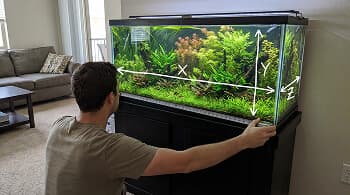
How to Measure Your Aquarium →
Not sure how to measure your tank dimensions? We have a complete visual guide with step by step instructions.
Click to see the full measuring guide
Recommended For Your Tank
Recommended gear for this setup
~45 gal tank
Water conditioners
Most likely add-on for larger stock lists and routine water changes.
Aquarium heaters
Stocking plans work better when temperature stays stable.
- DaToo Aquarium Heater Fish Tank Heater Submersible 100 Watt$9.984.2Budget 100W option for roughly 20-30 gallon tanks; useful when heater calculator lands in standard tropical mid-size range.
- AquaMiracle Aquarium Heater 100W with LED Digital Display$17.594.3Better 100W pick for 10-20 gallon tanks when users need digital temp display, dry-run shutoff, and overheat protection.
- HiTauing Aquarium Heater 100W with LED Digital Display$30.994.5Strong 100W candidate for 10-20 gallon tanks; adds digital control and multiple safety protections vs simple preset heaters.
As an Amazon Associate we earn from qualifying purchases.
What's Next?
You have a stocking plan. Now size the equipment to support it:
Filter & Flow →
Size filtration to handle the bioload you just planned for
Water Change Calculator →
Set a maintenance schedule that keeps your stock list healthy
Heater Calculator →
Match heater wattage to your tank and species temperature needs
Volume Calculator →
Get real water volume for accurate medication and treatment dosing
Setup Cost Calculator →
Budget the full build including livestock, filtration, and gear
What is the Stocking Calculator?
This calculator finds the first limiting factor (bioload, oxygen, or space) and uses that as your recommendation. It accounts for fish mass, waste production, surface area for oxygen exchange, and filtration capacity.
How it works: We calculate multiple constraints (bioload from volume, oxygen from surface area) and take the minimum. Recommended is where most stable tanks live long-term.
How to Use This Calculator
- Choose your input method: enter dimensions (length × width × height) OR just enter volume (gallons/liters)
- If using dimensions: select your tank shape (rectangular, cylinder, bowfront, etc.)
- Enter your measurements or select a common tank size
- Choose your fish archetype (affects mass, waste, and activity)
- Select your filtration level and tank maturity
- Enter the adult size of your fish (not current size!)
- See stability-based recommendations: high, moderate, and low stability levels
The complete guide to aquarium stocking: how many fish, which fish, and how to keep them healthy
Stocking is the decision that determines whether your aquarium is easy to maintain or a constant struggle. Get it right and the tank practically runs itself: water stays clean, fish behave naturally, maintenance is predictable, and the system is resilient enough to survive a missed water change or a busy week. Get it wrong and you are chasing ammonia spikes, battling algae, treating disease, and wondering why the tank that looked perfect on day one feels like a full-time job by month three.
This guide covers everything the calculator cannot tell you on its own: how to interpret the results, how to build a species list that actually works, how to stock in the right order, what makes some fish cost more biological capacity than others, and how to keep a stocking plan stable over the long term.
How to use this with the calculator above
The calculator gives you a number. This guide helps you turn that number into a species list, a stocking sequence, and a maintenance plan that keeps the tank healthy for years. Read the limiting factor in your result first, then use the relevant sections below to plan around it.
How to read the stability tiers
The calculator gives three stocking levels: high stability, moderate stability, and low stability. These are not good/better/best options. They are risk tiers. The right choice for most people is the high-stability number, and here is why.
- High stability is the range where the tank can absorb normal mistakes: a missed water change, slight overfeeding, a filter that needs cleaning, a fish that grows faster than expected. This is the number most hobbyists should target for long-term success.
- Moderate stability assumes you are running excellent filtration, doing consistent water changes, feeding carefully, and monitoring water parameters. Less margin for error. Workable for experienced keepers who maintain their tanks diligently.
- Low stability is expert-only territory. Small problems cascade fast. A skipped water change, a dead fish you did not notice, or a clogged filter can push the tank into crisis. Only attempt this with exceptional filtration, automatic water change systems, and real experience managing high-bioload tanks.
Beginners should aim for high stability and stay there until they have a year of successful maintenance under their belt. There is no prize for maxing out a tank. A slightly understocked tank is more beautiful, easier to manage, and far more enjoyable than one pushed to its biological ceiling.
What the limiting factor means and how to work with it
The calculator evaluates three independent constraints and reports whichever one limits you first. Understanding which constraint is active changes how you plan the rest of the build.
Bioload-limited: the filter and maintenance conversation
When bioload is the limiting factor, the tank has enough physical space and oxygen exchange for more fish, but the waste load would exceed what the system can process safely. This is the most common bottleneck and the one most affected by equipment and maintenance choices.
- Upgrading filtration (better media, more turnover, adding a sump or canister) genuinely raises bioload capacity. Use the filter and flow calculator to size filtration for the stock list you want, not the one you started with.
- Plants absorb nitrogen directly, which is why heavily planted tanks can safely hold more fish. The effect is real but not unlimited: a carpet of pearl weed does more than a single anubias.
- More frequent water changes effectively raise the bioload ceiling because you are exporting waste faster. A water change schedule tuned to your actual bioload keeps nitrates under control.
- Messy fish (goldfish, large cichlids, plecos) hit bioload limits much faster than clean feeders (tetras, rasboras). Two goldfish can produce as much waste as 15 neon tetras.
Oxygen-limited: the surface area problem
When oxygen is the bottleneck, the tank does not have enough gas exchange at the water surface to support more fish, regardless of filtration or volume. This is more common in tall, narrow tanks, tanks with restricted surface area (tight-fitting lids, floating plant coverage), and warm water (which holds less dissolved oxygen).
- Surface agitation is the primary driver of oxygen exchange. Increase it with a HOB filter output, airstone, or surface-breaking flow from a powerhead.
- Tall tanks with small footprints are the worst for oxygen. A 30-gallon tall (16" x 16" footprint) exchanges far less oxygen than a 30-gallon long (36" x 12" footprint).
- Higher temperatures mean lower dissolved oxygen. A tank at 82°F holds less oxygen than one at 76°F. Tropical fish in warm tanks hit oxygen limits before cold-water fish.
- Dense floating plant coverage (duckweed, salvinia, frogbit covering the entire surface) reduces gas exchange. Leave at least 30–40% of the surface open for air exchange.
Space-limited: the physics you cannot filter your way out of
When swimming space is the limiting factor, the tank simply is not large enough for more fish to swim, school, or hold territory naturally. This is a hard physical limit. No amount of filtration, maintenance, or plant coverage changes it.
- Active schooling fish (danios, barbs, rainbowfish) need horizontal length to swim. A 20-gallon tall does not give them what they need even though the volume is sufficient.
- Territorial fish need floor space and sight breaks (rocks, wood, plants that block line of sight between territories). Volume without structure does not reduce aggression.
- The only real fix for space limits is a bigger or differently shaped tank. This is the constraint you cannot work around with better equipment.
Why “one inch per gallon” does not work
The one-inch-per-gallon rule is the most widely repeated and least accurate stocking guideline in the hobby. It treats all fish as if they produce the same waste, need the same space, and have the same body mass per inch of length. None of that is true.
- A 10-inch oscar and ten 1-inch neon tetras are both “10 inches of fish,” but the oscar produces roughly 20–30x more waste, needs dramatically more swimming space, and weighs 100x more.
- A 6-inch goldfish produces more ammonia than a 6-inch angelfish because goldfish are rounder, heavier, and messier eaters. Body shape matters as much as length.
- Tall tanks and wide tanks with the same volume are completely different environments. The rule ignores tank dimensions entirely.
- It says nothing about behavior, oxygen, territory, or compatibility. A 10-gallon tank can safely hold a group of ember tetras but cannot hold a single dwarf gourami pair with room for both to feel comfortable.
The calculator above replaces this rule with a multi-constraint model that evaluates bioload, oxygen, and swimming space independently. Use it instead.
Fish archetypes: why some fish cost more biological capacity than others
Not all inches of fish are equal. The calculator uses archetypes to model the real differences in body mass, waste production, metabolic rate, and activity level between fish types. Understanding these differences helps you build a balanced stock list.
| Archetype | Body mass | Waste output | Space needs | Examples |
|---|---|---|---|---|
| Slim schooling | Low | Low–moderate | Moderate (group) | Neon tetras, rasboras, ember tetras |
| Active schooling | Low–moderate | Moderate | High (length) | Danios, barbs, rainbowfish |
| Deep-bodied / messy | High | High | Moderate | Angelfish, discus, large gouramis |
| Territorial dwarf | Moderate | Moderate | High (territory) | Apistos, dwarf gouramis, bettas |
| Goldfish | Very high | Very high | High | Fancy goldfish, common goldfish, comets |
| African cichlids | High | High | High (territory) | Mbuna, peacocks, haps |
| Bottom dwellers | Moderate | Low–moderate | Low–moderate | Corydoras, otocinclus, kuhli loaches |
When building a mixed stock list, run the calculator for the most demanding species in the tank. That species sets the per-fish capacity ceiling for the entire system.
Always stock for adult size: the most important rule
Fish at the store are almost always juveniles. A 1-inch clown loach will grow to 10+ inches. A 2-inch pleco might become a 15-inch tank buster. Even common community fish like angelfish and gouramis double or triple in size within 6–12 months. If you stock based on what the fish look like on purchase day, you are building a plan that expires.
Before you buy any fish, look up the adult size and enter that number into the calculator, not the current size. Some species that are commonly sold as small juveniles but grow far larger than expected:
- Common pleco: Sold at 2–3 inches, grows to 12–18 inches. Needs a 75+ gallon tank as an adult.
- Clown loach: Sold at 1–2 inches, grows to 10–12 inches. Needs a school and a very large tank.
- Bala shark: Sold at 3–4 inches, grows to 12–14 inches. Too large for most home aquariums.
- Iridescent shark: Sold at 3–5 inches, grows to 3–4 feet. This is a pond/commercial fish, not a home aquarium fish.
- Oscar: Sold at 2–3 inches, grows to 12–14 inches. A single oscar needs a 75-gallon minimum.
- Angelfish: Sold at 1–2 inches, grows to 6–8 inches tall. Needs a tank at least 18 inches tall and 20+ gallons per pair.
If the adult size of a fish does not fit your tank, do not buy it. “I will upgrade later” is the most common broken promise in the hobby.
Compatibility: the constraint the calculator cannot measure
The calculator tells you how many fish the tank can support biologically. It does not tell you which fish can live together peacefully. Compatibility is the second half of every stocking decision, and ignoring it is one of the fastest ways to turn a well-planned tank into a disaster.
Temperature and water chemistry compatibility
Fish that need fundamentally different water parameters should not share a tank. A neon tetra (soft, acidic, 72–78°F) and an African cichlid (hard, alkaline, 76–82°F) have almost no overlap in ideal conditions. Forcing one species to live in the other’s preferred water means chronic stress, weakened immunity, and shortened lifespan.
- Group fish by water chemistry: soft/acidic tropical, hard/alkaline cichlids, temperate/coldwater, brackish.
- Temperature overlap should be at least 4°F (2°C) across all species. Splitting the difference between a 72°F fish and an 82°F fish at 77°F leaves both outside their comfort zone.
- Use the heater calculator to size heating for the target temperature range of your actual species list.
Behavioral compatibility
Even fish with identical water parameter needs can be incompatible behaviorally. Fin nippers (some barbs, serpae tetras) with long-finned fish (bettas, guppies, angelfish). Fast, aggressive eaters with slow, shy feeders. Territorial bottom dwellers competing for the same cave. Breeding pairs that defend half the tank from everything else.
- Research aggression and temperament before mixing species, not after you see the problem.
- Schooling fish that are kept in groups too small (below 6) often become aggressive or stressed. A “school” of 3 tiger barbs is a fin-nipping gang, not a school.
- Territorial fish need actual territories: caves, wood, plant thickets, and sight breaks that divide the tank into zones.
- Some species are simply best kept in species-only setups: male bettas, puffers, aggressive cichlid pairs, and anything large enough to eat its tankmates.
Zone compatibility
Fish occupy different vertical zones in the tank: top dwellers (hatchetfish, surface feeders), mid-water swimmers (tetras, barbs, rainbowfish), and bottom dwellers (corydoras, loaches, plecos). A well-stocked tank distributes fish across zones so the space feels full without any single level being overcrowded. Stacking too many species in the same zone creates competition for the same space even when total volume is fine.
How to stock in stages: the safe stocking sequence
Even if your final stock list fits the calculator result perfectly, adding everything at once is a common mistake. The biofilter (beneficial bacteria) grows in response to ammonia production. Doubling the bioload overnight can overwhelm bacteria that were calibrated for a lighter load, causing an ammonia spike even in a fully cycled tank.
The right approach is to stock in waves, waiting 1–2 weeks between each addition for the biofilter to catch up. Here is a general stocking order that works for most community builds:
- 1
Hardy foundation fish (week 1–2 after cycle)
Start with the toughest, most adaptable species in your plan. Corydoras, danios, or white cloud mountain minnows are classic first residents. They tolerate minor parameter fluctuations and help establish the biofilter for the fish that follow.
- 2
Main schooling groups (weeks 3–6)
Add your primary schools (tetras, rasboras, barbs) in full groups, not one or two at a time. Schooling fish feel more secure and behave better when added as a complete group. Test water parameters before and 48 hours after each addition.
- 3
Sensitive or territorial species (weeks 6–10)
More delicate species (discus, dwarf cichlids, specialty shrimp) should go in last when the tank is fully established and parameters are stable. Territorial fish added last also have less time to claim the entire tank as “theirs” before other residents are settled.
- 4
Centerpiece fish (when everything else is stable)
If your plan includes a showpiece (a pair of angelfish, a gourami, or a centerpiece cichlid), add them last. They get the benefit of an established, stable environment, and the existing residents help reduce the centerpiece’s tendency to dominate.
Between each wave, test ammonia, nitrite, and nitrate. If ammonia or nitrite reads above 0 ppm, stop adding fish until parameters reset to zero. If nitrate is climbing rapidly, your maintenance schedule may need adjusting before the tank can handle more bioload.
Schooling fish: minimum group sizes and why they matter
Schooling and shoaling fish are social animals. Keeping them in groups that are too small causes stress, erratic behavior, aggression, color loss, and shortened lifespan. The fish may survive alone or in pairs, but they do not thrive. Minimum group sizes are not suggestions; they are requirements for humane and effective fishkeeping.
- Most tetras, rasboras, and danios: Minimum 6, ideally 8–12+. Larger groups produce better schooling behavior and more natural color display.
- Corydoras: Minimum 6 of the same species. They are social and more active in groups. Mixing species counts toward social interaction but same-species groups are best.
- Tiger barbs, cherry barbs: Minimum 6–8. In groups below 6, tiger barbs redirect schooling energy into fin-nipping tankmates.
- Loaches (kuhli, clown, etc.): Minimum 5–6. They hide constantly in small numbers and become active and visible in larger groups.
- Rainbowfish: Minimum 6. Males display their best color and behavior when competing within a group.
If the calculator result says you can keep 8 fish and the species you want needs a minimum group of 6, that leaves very little room for additional species. Either commit to a species-focused tank or choose a species that works in smaller groups.
How tank shape changes stocking even at the same volume
Two tanks with identical volume can support very different stocking plans depending on their dimensions. The calculator accounts for this through swimming space and surface area calculations, but understanding why helps you make better species choices.
- Long tanks (standard 20L, 30L, 55 gal, 75 gal): Best for active swimmers, schooling fish, and species that need horizontal cruising room. The length gives schools space to move, and the wider footprint provides more surface area for oxygen exchange.
- Tall tanks (20H, column tanks, hex tanks): Worse for most fish despite looking impressive. Less surface area per gallon means less oxygen. Less horizontal space means schooling fish cannot swim properly. Better for vertically oriented species (angelfish, discus to some extent) but even they need some horizontal room.
- Bowfront and corner tanks: The curved glass creates visual interest but slightly reduces usable swimming space. Fish do not use the narrowing corners as effectively as a rectangular footprint.
- Cube tanks: A compromise. Equal dimensions in all directions. Works for species that do not need long runs but want vertical space.
When in doubt, a longer, wider tank is almost always better than a taller one. The extra footprint helps with filtration placement, plant layout, territory division, and oxygen exchange.
How filtration, plants, and maintenance expand or shrink stocking capacity
The calculator uses your filtration setting as a modifier because it genuinely changes how much bioload the tank can handle. But it is worth understanding the mechanics so you do not overestimate the effect.
- Upgrading from a basic sponge/HOB to a canister or sump increases biological media volume, flow consistency, and mechanical filtration. This can support 15–25% more bioload depending on the system.
- Live plants absorb nitrogen directly, effectively adding a second export path alongside filter bacteria. Heavily planted tanks with fast-growing stems can handle significantly higher stocking than bare tanks of the same size. But if the plants melt back (which happens), that buffer disappears.
- Water change frequency and volume are the most underrated stocking variable. A tank that gets 30% weekly changes can support more fish than an identical tank that gets 15% biweekly changes, because nitrate is being exported faster.
- Feeding discipline matters more than most people realize. A heavily stocked tank with careful, measured feeding produces less waste than a lightly stocked tank where food is dumped in carelessly.
The safest approach: stock for the high-stability number, then let water tests confirm whether the system can handle the load. If ammonia and nitrite stay at zero and nitrate stays below 20–40 ppm between water changes, the tank is handling its current bioload well. If nitrate climbs above 40 ppm before your next scheduled change, either reduce feeding, increase water change frequency/volume, or accept that the tank is at its practical limit.
Quarantine: the step most people skip and regret
Every new fish is a disease vector. Even healthy-looking fish from clean stores can carry ich, bacterial infections, internal parasites, or other pathogens that only manifest under the stress of transport and acclimation. Adding infected fish directly to a display tank puts every existing resident at risk.
A quarantine setup is simple and cheap: a spare 5–10 gallon tank (depending on fish size), a sponge filter (seeded from the main tank), a heater, a lid, and basic medications on hand. Total cost: $50–$100. That investment protects a display tank worth 10–50x more.
- Quarantine new fish for 2–4 weeks minimum. Observe for white spots, clamped fins, rapid breathing, loss of appetite, or unusual behavior.
- Some keepers prophylactically treat all new arrivals with a mild anti-parasitic (Praziquantel) and antibacterial during quarantine. This is standard practice in serious fishrooms.
- If you do not quarantine, stock more slowly and watch existing fish carefully after each addition. The first sign of disease usually appears within 3–7 days of introducing new fish.
The most expensive stocking mistakes and how to avoid each one
- 1.
Stocking for juvenile size. Planning around what the fish looks like at the store instead of its adult size. A 2-inch pleco becomes a 15-inch pleco. A 1-inch angelfish becomes a 6-inch angelfish. Always use adult dimensions in the calculator.
- 2.
Adding everything at once. Dumping the entire stock list into a freshly cycled tank overwhelms the biofilter. Stock in waves over 4–8 weeks, testing between each addition.
- 3.
Keeping schooling fish in groups that are too small. Three neon tetras is not a school. Three tiger barbs is a fin-nipping gang. Buy the minimum group size (6+) or choose a different species that works in smaller numbers.
- 4.
Ignoring compatibility. Mixing aggressive and peaceful species, fast and slow eaters, or species with incompatible water parameters. Research every species before adding it to the plan.
- 5.
Impulse buying at the fish store. “That looks cool” is not a stocking plan. Impulse purchases lead to compatibility problems, overcrowding, and returns that most stores do not accept.
- 6.
Assuming more filtration fixes everything. Filtration helps with bioload but does not create more swimming space, more territory, or more oxygen in a tank with poor surface exchange. Respect all three constraints, not just the one you can buy your way out of.
How to build a balanced stock list: step by step
- Start with the tank, not the fish. Run the calculator for your tank size and shape. Note the high-stability number and the limiting factor.
- Choose your centerpiece or primary species first. This is the fish that drives the tank concept. Everything else fits around it.
- Add mid-water schools. Pick one or two schooling species that complement the centerpiece in temperament, size, and water zone. Check water parameter overlap.
- Add bottom dwellers. Corydoras, loaches, or otocinclus for the substrate zone. They use space the mid-water fish do not need.
- Add a cleanup crew. Nerite snails, amano shrimp, or similar utility species. These add minimal bioload and provide real cleaning benefit.
- Check the total against the calculator result. If you are over the high-stability number, remove the least essential species or reduce group sizes (but never below minimum school size).
- Plan the stocking order. Hardy first, sensitive last, centerpiece last. Allow 1–2 weeks between additions.
What a well-stocked tank actually looks like
A properly stocked tank does not look empty. It looks intentional. The fish have room to swim naturally, schools move together, territories are respected, and the tank feels alive without feeling crowded. Maintenance is predictable: nitrates rise at a manageable rate, water changes keep up, and the filter can handle a day or two of delayed maintenance without a crisis.
If you are constantly asking “can I add one more fish?” the answer is usually that the tank already told you what it wants. The best aquariums are not the ones packed to capacity. They are the ones where every fish has a purpose, every species fits the environment, and the system is stable enough that you can enjoy watching it instead of worrying about it.
A slightly understocked tank is easier to manage, safer through mistakes, more resilient to disruption, and more beautiful than a tank pushed to its biological ceiling. Leave room. The tank will thank you for it.