Aquarium Setup Cost Calculator
What is the Aquarium Setup Cost Calculator?
This calculator estimates how much it will cost to get a tank running based on size, setup style, and gear quality. It turns your dimensions or volume into a realistic equipment budget instead of a vague guess.
Freshwater, planted, saltwater, and reef tanks have very different lighting, filtration, rock, and testing costs. Use this to plan the full build before you start buying gear piece by piece.
How to Use This Calculator
- Enter your tank dimensions or total volume.
- Choose the setup style you want to build.
- Pick a budget tier that matches the quality level you want.
- Toggle whether to include stand, livestock, used gear, and RO/DI.
- Review the total estimate and line-item breakdown before you shop.
How would you like to enter your tank info?
What's your tank shape?
Enter Your Tank Dimensions
What kind of setup are you pricing?
Choose your tank style
How premium should the gear be?
What should this budget include?
The 'Second Wave': Many hobbyists only budget for the tank itself. We include a 'first month' estimate because extra tools, media, and forgotten supplies usually add 15-20% to the initial build.
Need Help Measuring Your Tank?
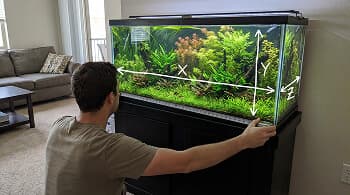
How to Measure Your Aquarium →
Not sure how to measure your tank dimensions? We have a complete visual guide with step by step instructions.
Click to see the full measuring guide
What's Next?
Now that you have a budget range, size each piece of equipment before you shop:
Substrate Calculator →
Turn your footprint into exact bag counts before checkout
Filter & Flow →
Size filtration to your bioload so you buy the right filter once
Heater Calculator →
Match heater wattage to your tank size and room temperature
Light Calculator →
Find the right PAR and fixture for your plants or corals
Volume Calculator →
Size conditioners, treatments, heaters, and filters from net volume
Weight Calculator →
Check total system weight before your stand and floor are loaded
What is the Aquarium Setup Cost Calculator?
This calculator estimates how much it will cost to get a tank running based on size, setup style, and gear quality. It turns your dimensions or volume into a realistic equipment budget instead of a vague guess.
Freshwater, planted, saltwater, and reef tanks have very different lighting, filtration, rock, and testing costs. Use this to plan the full build before you start buying gear piece by piece.
How to Use This Calculator
- Enter your tank dimensions or total volume.
- Choose the setup style you want to build.
- Pick a budget tier that matches the quality level you want.
- Toggle whether to include stand, livestock, used gear, and RO/DI.
- Review the total estimate and line-item breakdown before you shop.
The complete guide to aquarium setup costs: what every build actually costs and why
Setting up an aquarium is not one purchase. It is a project with dozens of line items, at least three spending waves, and a long tail of monthly costs that most people discover after the fact. The price printed on a tank at the pet store is roughly the same percentage of total build cost as a front door is to a house: visible, necessary, and nowhere close to the full number.
This guide breaks down every cost category, explains why prices diverge so much between freshwater and reef, shows you where most people overspend or underspend, and gives you a practical framework for budgeting a build that does not collapse under surprise expenses in month two. Whether you are planning a first 10-gallon betta tank or a 120-gallon reef, the structure is the same. Only the dollar amounts and the weight of each category change.
How to use this with the calculator above
Run the calculator first to get your total range. Then read through each category below to understand what sits inside that number. Knowing the split helps you decide where to spend more, where to save, and what you can defer to month two without risk.
Where the money goes: budget share by setup type
The table below shows approximate first-year percentages for each major cost bucket. These shift with tank size, brand preference, DIY skill, and geography, but they are a useful sanity check for spotting a budget that is dangerously lopsided: spending 60% on the tank and 5% on filtration for a reef, for example, almost always ends in expensive corrections.
| Category | Freshwater | Planted | Saltwater | Reef |
|---|---|---|---|---|
| Tank & stand | 40–50% | 30–40% | 25–35% | 20–30% |
| Filtration & flow | 12–18% | 12–18% | 15–22% | 18–25% |
| Lighting | 8–12% | 20–28% | 10–16% | 25–35% |
| Heating & basics | 5–8% | 4–7% | 4–7% | 3–6% |
| Substrate & hardscape | 10–18% | 12–20% | 10–16% | 8–15% |
| Water prep, tests, consumables | 5–10% | 6–12% | 8–14% | 8–15% |
| Livestock, plants, or coral | 10–20% | 10–18% | 12–22% | 15–25% |
Notice how the tank-and-stand share drops from nearly half the budget on a basic freshwater build to roughly a quarter on a reef. The money does not disappear; it shifts into lighting, filtration, water chemistry, and livestock. That is why two 55-gallon tanks can cost $400 and $3,000 depending on what lives inside them.
Tank and stand: the foundation everything else sits on
The glass box and what holds it are the most visible line items, and on a basic freshwater community tank they are often the largest single expense. That changes as builds get more complex: on a reef, the tank and stand might only represent 20–25% of the total even though the absolute dollar amount is still significant.
Tanks come in three rough price tiers. Standard rimmed tanks with basic glass are the cheapest. Starter kits that bundle a lid, light, and sometimes a filter land in the middle and can be a genuine value if the included equipment matches your goals. Rimless or ultra-clear glass tanks cost more per gallon but look dramatically better for display builds and planted aquascaping.
Stands are where many people try to save money and regret it later. A proper aquarium stand distributes weight evenly and handles the static load of water, glass, rock, and substrate for years without sagging, twisting, or moisture damage. Furniture repurposed as a tank stand may look fine at first but can fail structurally, especially once humidity and occasional splashes take their toll. The weight calculator can tell you exactly how heavy your filled system will be, which helps you evaluate whether a stand (or floor) is rated for the job.
- All-in-one kits sometimes bundle a filter and light. Compare the bundle price to buying pieces separately, because the included gear may not match your actual plan and ends up replaced anyway.
- Used tanks can save 30–50% but budget $20–$60 for resealing silicone, replacing missing lids or trim, and inspecting for stress cracks or chips.
- Delivery and tax are easy to forget. A 75-gallon tank shipped to your door can add $50–$150 in freight alone.
- Custom or non-standard sizes cost significantly more than common dimensions (10, 20, 29, 40B, 55, 75) because manufacturing runs are smaller and stands may need to be custom-built or ordered.
Filtration and circulation: the invisible workhorse
Filtration is the single most important piece of equipment for long-term tank stability, and underspending here is the fastest way to create problems that cost more to fix than the filter you skipped. A filter that cannot keep up with your bioload leads to poor water quality, algae, stressed or sick fish, and an expensive second purchase once you realize the original was undersized.
For freshwater community tanks, a hang-on-back (HOB) filter or entry-level canister is usually enough. Planted tanks often do well with canisters that provide gentle, consistent flow and good media capacity. Marine fish-only tanks need more turnover and usually add dedicated circulation pumps or powerheads. Reef systems push filtration costs the highest because they typically require a sump, protein skimmer, return pump, wavemakers, and possibly reactors or refugium lighting.
Before you buy, use the filter and flow calculator to turn your tank volume and stocking plan into a realistic GPH target. Filter packaging often claims “up to X gallons,” but that rating assumes light stocking and perfect conditions. Sizing for the GPH number instead of the gallon label gets you a filter that actually handles your build.
- Budget $15–$40 for replacement sponges, cartridges, or bulk biomedia within the first year. Filter media is a recurring cost most people discover after the first dirty cartridge.
- Powerheads and wavemakers for dead-zone elimination are easy to forget in a spreadsheet but matter for tanks longer than 36 inches or any marine setup.
- If you are considering CO2 injection for a planted tank, factor in the regulator, cylinder, diffuser, and drop checker. That can add $150–$400 to the filtration and life-support budget depending on quality.
Lighting: the biggest cost swing between setup types
No single category varies more across setup types than lighting. A basic LED strip for a fish-only freshwater tank can cost $20–$60. A quality planted-tank light with enough PAR to grow carpeting plants runs $80–$300+. A reef light capable of sustaining SPS corals on a 24-inch-deep tank can easily hit $300–$800 per fixture, and large tanks often need two or three fixtures for full coverage.
The mistake most people make is buying for the tank they have today rather than the tank they want in six months. If you know you want high-light plants, demanding corals, or a specific aquascaping style, buying a weak fixture first is literally paying twice: once for the light you outgrow and again for the one you actually needed. If you are planning a low-tech planted tank with anubias, java fern, and crypts, a moderate light works fine and you can put the savings into better substrate and more plants instead. Use the light calculator to match fixture output to your tank depth and goals.
- Fish-only freshwater: $20–$60 for a basic LED is usually enough. Color rendering matters more than raw PAR.
- Low-tech planted: $50–$120 for a decent planted LED. Look for fixtures in the 30–60 PAR range at substrate level.
- High-tech planted: $120–$350. You need enough output to drive a carpet and justify the CO2 system you are pairing it with.
- Reef: $250–$800+ per fixture. Corals need specific spectrum and intensity, and the light often becomes the single most expensive item in the entire build.
Heating, temperature control, and small hardware
Heaters are cheap relative to the damage a temperature swing can cause. A $25 heater failing in a $2,000 reef tank is a real scenario, so this is a category where reliability matters more than saving $10. For tanks under 40 gallons, a single adjustable submersible heater is standard. For larger tanks, two smaller heaters provide redundancy: if one fails off, the other keeps the tank warm; if one fails on, it cannot overheat the full volume as fast. Use the heater calculator to size wattage based on your tank volume and room temperature.
This category also includes the small hardware that nobody photographs but everyone needs before day one: thermometer (digital stick-on or probe), lid or mesh top, algae scraper or magnetic cleaner, fish net, gravel vacuum or siphon hose, buckets (at least two), towels, power strips rated for the load, a timer for the light, and possibly an extension cord. These items collectively add $60–$150 to a medium build and are the definition of “forgotten extras.”
- Cold rooms (below 68°F / 20°C ambient) need more wattage, which raises both the heater cost and monthly electricity.
- Reef keepers in warm climates may also need a chiller or fans, which can add $100–$400+ to the temperature control line.
- A simple digital thermometer ($8–$15) is worth more than a $5 stick-on strip because it actually shows you the real temperature accurately.
Substrate, hardscape, and aquascaping materials
This is one of the easiest categories to overshoot because each bag of gravel or piece of driftwood feels small until you add them up. Substrate is sold by the bag (typically 5–20 lbs), rock by the pound or piece, and wood by individual pieces that range from $10 to $80+ for large, dramatic shapes.
The type of substrate matters enormously for both cost and function. Inert gravel or sand costs $1–$2 per pound. Active aquasoil for planted tanks runs $20–$35 per 9-liter bag and you may need 2–4 bags for a 40-gallon tank. Live sand and dry rock for marine setups are priced by weight and coverage area. Reef rock, whether dry or live, is typically $3–$8 per pound and a 75-gallon reef might need 50–100 lbs. Use the substrate calculator to convert your target depth and tank footprint into exact bag or weight requirements before you load the cart.
- Budget for glue (cyanoacrylate gel), zip ties, and possibly epoxy if you are building complex hardscape structures.
- Backgrounds (vinyl, paint, or 3D foam) add $10–$50 but are much easier to install before the tank is filled.
- Planted tanks often layer substrates: a nutrient base under a cap of sand or fine gravel. Both layers count toward the budget.
- Dragon stone, seiryu stone, and spider wood are popular but can be expensive in large quantities. Price per pound before you design the scape, not after.
Water chemistry, testing, and startup consumables
Every tank needs dechlorinator (water conditioner) from fill day forward. Beyond that, the consumable list grows with complexity. Freshwater community tanks need conditioner, starter bacteria for cycling, and a basic liquid test kit covering ammonia, nitrite, nitrate, and pH. Planted tanks add fertilizers (liquid or root tabs) and possibly pH buffers. Marine tanks add salt mix, hydrometer or refractometer, and alkalinity or calcium testing. Reef tanks add even more: magnesium testing, trace element supplements, carbon dosing supplies, and sometimes automated dosing pump consumables.
Test kits are the most commonly forgotten budget item. A quality liquid test kit (API Master or equivalent) runs $25–$40 and covers the nitrogen cycle. Marine hobbyists often spend $80–$200+ on testing gear in the first year between standard and reef-specific parameters. Do not skip testing to save money. A $30 test kit can prevent a $300 fish kill.
- Budget for refills, not just the first bottle. Dechlorinator, bacteria, and fertilizers are recurring costs that start immediately.
- Bacterial starter products ($10–$25) genuinely help establish the nitrogen cycle faster, reducing the time your empty tank sits doing nothing.
- Marine setups: factor in the cost of salt mix ($15–$50 per bucket depending on brand and volume), mixing containers, and a powerhead for mixing.
- RO/DI units ($100–$300+) are practically mandatory for reef and recommended for sensitive freshwater species. Replacement filters and membranes add $40–$80 per year.
Livestock, plants, corals, and cleanup crew
The animals and plants are the reason the tank exists, yet they are frequently left out of the initial budget or dramatically underestimated. A single school of 12 cardinal tetras costs $40–$70. A pair of clownfish runs $30–$60. A single high-end coral frag can cost $50–$200. A full stocking plan for a 55-gallon planted community tank with multiple schools, a centerpiece fish, shrimp, and snails easily reaches $150–$400.
Quality matters here more than quantity. Healthy fish from a reputable source (local fish store with quarantine practices, trusted online breeders) cost more than big-box impulse buys but arrive in better condition and are far less likely to introduce disease. If you are spending $1,500 on a reef build, buying $8 corals from a questionable source to save money is a false economy.
- Stock slowly. You do not need to fill the tank on day one, and your biofilter cannot handle a full load immediately after cycling anyway.
- Quarantine equipment (a spare 10-gallon, sponge filter, heater, and basic meds) costs $50–$100 and can save hundreds in prevented disease outbreaks.
- Cleanup crew (nerite snails, amano shrimp, corydoras, or marine hermit crabs and snails) are a functional purchase, not just decoration. Budget $20–$60 for a reasonable starter crew.
- Plants are livestock too. A well-planted 20-gallon can easily cost $60–$120 in plant purchases if you want good coverage from day one rather than waiting months for propagation.
The three spending waves that define every aquarium build
Money does not leave your account in one clean lump. It arrives in waves, and the second and third waves are where budgets break because most people only plan for the first one.
- 1
Hardware wave (weeks 1–2)
Tank, stand, filter, heater, light, power strips, timer, basic tools. This is the wave people actually plan and budget for. It feels like the big expense, and it is, but it is rarely more than 50–60% of the real first-year total.
- 2
Wet startup wave (weeks 2–4)
Substrate, hardscape, fill water, conditioners, bacteria, first plants or live rock, test kits, small fixes, “one more bag of gravel,” the scraper you forgot, and the bucket you borrowed from cleaning supplies and now need to replace. This is where sticker shock hits. Individual items feel small ($8 here, $15 there) but they stack fast. Typically 20–30% of total spend.
- 3
Stocking and finish wave (months 1–3)
Full fish list, remaining corals or invertebrates, the better light you realized you needed, CO2 setup, auto top-off, auto feeder, backup heater, and the media upgrade you put off. This wave often accounts for 20–40% of total first-year spend. It is not a failure of planning; it is the nature of the hobby. Budgeting for it prevents financial stress during the cycle and early stocking phase.
Monthly and annual running costs: what the hobby actually costs to maintain
Setup cost is a one-time hit. Running cost is what you pay every month for as long as the tank exists. For a freshwater community tank, expect $15–$35 per month in consumables (food, conditioner, occasional media, fertilizer if planted). Reef tanks run higher: $50–$120+ per month for salt mix, supplements, RO membrane replacements, test reagents, and premium food.
Electricity is the recurring cost everyone wonders about but few calculate. A typical freshwater setup (filter, heater, light on timer) adds $5–$15 per month to an electric bill depending on tank size and local rates. Reef tanks with high-output lighting, multiple pumps, a skimmer, and possibly a chiller can add $20–$50+ per month. These are not exact numbers; they depend on equipment efficiency, ambient temperature, and your utility rate, but they give you a ballpark for monthly budgeting.
- Annual replacements to budget for: filter media ($20–$60), light bulbs or LED panel if aging ($0 for quality LEDs, $30–$80 for T5/T8), heater if the old one shows corrosion ($15–$40), air pump diaphragm ($5–$10), and test kit refills ($15–$30).
- Emergency fund: Equipment can fail. A heater that sticks on, a pump that seizes, or a cracked lid happens to everyone eventually. Keeping $50–$100 in mental reserve for a replacement purchase prevents a crisis from becoming a catastrophe.
Real-world build cost examples
These are not exact quotes. They are representative ranges based on typical builds to help you calibrate expectations. Your actual costs depend on brands, sales, used vs new, and local pricing.
| Build | Starter | Mid-range | Premium |
|---|---|---|---|
| 10 gal freshwater | $120–$180 | $200–$350 | $350–$550 |
| 29 gal planted | $300–$450 | $500–$800 | $900–$1,400 |
| 55 gal freshwater | $400–$600 | $700–$1,100 | $1,200–$1,800 |
| 40B reef | $800–$1,200 | $1,500–$2,500 | $3,000–$5,000 |
| 120 gal reef | $2,000–$3,500 | $4,000–$7,000 | $8,000–$15,000+ |
These ranges include equipment, substrate, hardscape, consumables, and a reasonable first livestock wave. They do not include ongoing monthly costs or major upgrades in year two.
If money is tight: where to spend and where to save
You cannot buy everything at the top tier, and you should not try. A smart budget puts money where failure is expensive and saves where the consequences are cosmetic. Here is a practical priority order:
- Stand and structural support: Non-negotiable. A stand failure means water on the floor, broken glass, and dead livestock. Buy or build something rated for the weight.
- Filtration for your actual bioload: Undersizing here creates water quality problems that stress fish, grow algae, and force a second purchase. Size it right the first time.
- Reliable heater and thermometer: Temperature instability kills fish silently. A $25 adjustable heater with a separate digital thermometer for verification is a minimum.
- Dechlorinator and basic test kit: Non-optional. Chlorine kills bacteria and fish. Testing confirms your cycle and catches problems before they become visible.
- Lighting matched to your actual goal: Buy for the tank you are building. Cheap light for fish-only is perfectly fine. Cheap light for a planted or reef tank is a waste because you will replace it.
- Substrate and hardscape: Important for aesthetics and planted/reef function, but easier to upgrade or supplement later than filtration or heating.
- Livestock: Buy fewer, healthier fish from better sources. One healthy school looks better and lives longer than a tank full of stressed discount fish.
The “buy once vs buy twice” decision framework
Entry-level gear that matches a simple plan is perfectly fine. A $15 HOB filter on a lightly stocked 10-gallon betta tank is not a mistake. Entry-level gear that fights your actual goal is expensive because you replace it within months. The classic pay-twice mistakes:
- A $30 clip-on light on a tank you want to carpet with Monte Carlo. You will buy a $150+ planted light within two months.
- A filter rated for “up to 20 gallons” on a 20-gallon tank stocked with messy fish. Real-world capacity is closer to 10–12 gallons of actual bioload.
- A particleboard stand for a 55+ gallon tank. It will sag, swell from moisture, and eventually fail.
- A basic freshwater heater used in a saltwater setup without a controller or backup. Salt accelerates corrosion and failure risk.
If you already know your end state (reef, high-tech planted, large cichlid tank), bias the budget toward equipment that survives the upgrade path rather than buying the cheapest thing first and replacing it.
Buying used: what to look for and what to avoid
Used aquarium gear can save 30–60% on the biggest-ticket items. But not all used equipment is created equal. Here is a category-by-category breakdown:
- Tanks: Great to buy used. Inspect every seal, every corner, and look for chips or scratches in the glass. Budget $15–$40 for resealing with aquarium-safe silicone if seals look old or dried. Run a water test outdoors for 48 hours before trusting it indoors.
- Stands: Good to buy used if they are solid wood or metal. Avoid used particleboard stands; moisture damage may not be visible until weight is applied. Check for level, rust, and any structural flex.
- Filters: Canisters and HOBs can be good used purchases. Replace all seals, O-rings, and impellers as a matter of course. The motor is the expensive part and usually survives well.
- Lights: LED fixtures age slowly and can be good used buys. T5 fixtures lose output over time, so factor in new bulb cost. Reef lights should come with proof of purchase date or at least firmware version to estimate remaining lifespan.
- Heaters: Generally not recommended used. They are cheap new, and a failed heater (stuck on or stuck off) can kill an entire tank. The risk-reward ratio is poor.
- Skimmers and pumps: Can be good used if you can verify they run quietly and without excessive wear. Ask for a video of the unit running before buying.
Contingency budget: the line item that saves the project
Something will cost more than expected. An extra bag of substrate because the depth looked thin. A heater that arrives DOA. Shipping that was $15 more than quoted. A sale price that ended the day before you ordered. Tax you forgot to include. These are not disasters; they are normal. Holding 10–15% of the total build aside as contingency turns each surprise into a minor annoyance instead of a budget crisis. If you do not spend the contingency fund, it becomes your first month of maintenance money or your starter livestock budget.
The most expensive beginner mistakes (and how to avoid each one)
- 1.
Budgeting only for the tank. The glass is 20–50% of total cost depending on setup type. If you budget $200 for a tank and nothing else, you will spend $200 more within two weeks on everything the tank needs to actually run.
- 2.
Buying the cheapest version of everything. Budget gear for a budget build is fine. Budget gear for a build that wants premium results creates a cascade of replacements. Pick your tier and stay consistent.
- 3.
Skipping the cycle. Trying to add fish before the nitrogen cycle is established leads to fish loss, emergency medication purchases, and sometimes a complete restart. A $10 bottle of bacteria starter and 4–6 weeks of patience saves hundreds.
- 4.
Impulse livestock purchases. Adding fish because they looked cool at the store without checking compatibility, adult size, or whether your tank can support the bioload. Returns are rare in this hobby. Research before you buy.
- 5.
Ignoring ongoing costs. The tank costs money every month it exists. Food, water conditioner, electricity, filter media, and test reagents are real recurring expenses. A reef tank that was affordable to build can be expensive to maintain if you did not factor in salt mix, supplements, and replacement RO membranes.
Putting it together: from calculator result to shopping list
Here is the recommended workflow for turning a budget estimate into an actual plan:
- Run the calculator above for your tank size, setup type, and budget tier. Note both the low and high end of the range.
- Read the line-item breakdown to see where your money is going. If one category looks surprisingly high or low, that is where to investigate further.
- Map each line item to a real product. Search for specific filters, lights, heaters, and substrate that fit both the function and the budget. Price them individually and compare to the calculator estimate.
- Run the specialized calculators for the items that need sizing: substrate, filter & flow, heater, light, and weight.
- Split your shopping into waves. Wave 1: tank, stand, filter, heater, light, power strips, timer, basic tools. Wave 2: substrate, hardscape, water prep, test kits. Wave 3: livestock, plants, or corals after the cycle confirms stable water.
- Hold 10–15% back as contingency. Spend it on surprises, or use it for livestock if everything goes smoothly.
The goal is not a perfect forecast. No build goes exactly to plan. The goal is walking into the fish store with a number that still works after wave two, a clear priority order for where quality matters most, and the confidence that you are not going to run out of budget before the tank is actually running.