Aquarium Heater Calculator
What is the Aquarium Heater Calculator?
This calculator determines the exact wattage required to maintain your target water temperature. Unlike simple 'watts-per-gallon' rules, we account for the 'temperature lift', the difference between your room's ambient temperature and your desired tank temperature.
Accurate heater sizing prevents 'tank crashes' from underpowered units during winter and reduces the risk of overheating from overpowered units.
How to Use This Calculator
- Input your aquarium volume or dimensions
- Set your average room temperature (ambient)
- Set your target water temperature for your specific fish
- View the recommended wattage and safety tips for redundancy
- Consider using two smaller heaters for larger tanks to provide a fail-safe
How would you like to enter your tank info?
What's your tank shape?
Enter Your Tank Dimensions
Temperature Settings
Need Help Measuring Your Tank?
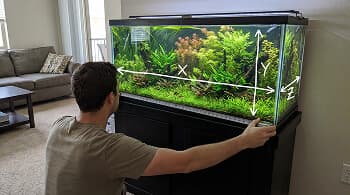
How to Measure Your Aquarium →
Not sure how to measure your tank dimensions? We have a complete visual guide with step by step instructions.
Click to see the full measuring guide
Recommended For Your Tank
Recommended gear for this setup
~45 gal tank · 180W heat
Aquarium test kits
Good for checking whether temperature swings are stressing the tank.
Filters for stable systems
Heating and filtration are usually the two core hardware decisions together.
- Fluval 307 Performance Canister Filter (up to ~70 gal)$189.994.4Strong brand-name canister for mid-size tanks when turnover math points to serious flow; quieter eTEC pump vs many budget canisters.
- Fluval 407 Performance Canister Filter (up to 100 gal)$229.994.5Fix for low turnover; quiet, high capacity enthusiast upgrade.
- Fluval FX2 High Performance Canister Filter$244.374.2Premium upgrade for large-tank flow; step up from HOB.
As an Amazon Associate we earn from qualifying purchases.
What's Next?
Complete your aquarium setup with these helpful calculators:
What is the Aquarium Heater Calculator?
This calculator determines the exact wattage required to maintain your target water temperature. Unlike simple 'watts-per-gallon' rules, we account for the 'temperature lift', the difference between your room's ambient temperature and your desired tank temperature.
Accurate heater sizing prevents 'tank crashes' from underpowered units during winter and reduces the risk of overheating from overpowered units.
How to Use This Calculator
- Input your aquarium volume or dimensions
- Set your average room temperature (ambient)
- Set your target water temperature for your specific fish
- View the recommended wattage and safety tips for redundancy
- Consider using two smaller heaters for larger tanks to provide a fail-safe
Aquarium heater guide: wattage, placement, and stable temperature
A heater result is not just a shopping number. It is the starting point for keeping your aquarium stable through winter nights, room temperature swings, and everyday equipment failure. Fish handle the right temperature far better than they handle repeated temperature changes, so the goal is not chasing perfection every hour. It is building a setup that keeps the tank reliably in range with as little drama as possible.
How to read your wattage estimate
Your result is really a measure of how much heat the tank needs to gain and keep. The biggest variable is the gap between room temperature and target tank temperature, and how much water you are actually heating, which is why it helps to know your net tank volume (substrate and hardscape steal more water than people expect). A tank in a warm living room and the same tank in a cold basement can need very different heaters. If you entered a daytime room temperature but the room drops much lower overnight, the heater may seem underpowered even though the original estimate was technically correct for warmer hours.
- Use the coldest realistic room temperature your tank experiences, not the most comfortable daytime number.
- If you are between sizes, choose the option that gives you a little margin instead of forcing the heater to run flat out.
- Lids, evaporation, room drafts, and sump setups can all increase heating demand beyond what you expected.
One heater or two?
For small tanks, one correctly sized heater is usually fine. For medium and large tanks, two smaller heaters are often the safer choice. Splitting the load gives you better coverage, reduces the impact of one bad heater, and often keeps temperature more even from one end of the tank to the other. If one heater fails off, the other can buy you time. If one fails on, a smaller individual unit is less likely to cook the tank quickly.
- Single heaters are simpler, but they create one obvious point of failure.
- Dual heaters spread heat more evenly and are a strong upgrade for larger or more valuable setups.
- An external temperature controller adds another layer of protection if stability really matters.
Simple upgrade that pays off
Always use a separate thermometer even if the heater has a display. The heater tells you what it thinks it is doing. The thermometer tells you what the tank is actually doing.
Choosing between glass, titanium, and preset heaters
Heater type matters once you move beyond the wattage number. Adjustable glass heaters are common and affordable, but quality varies. Titanium heaters are durable and popular on larger systems, especially when paired with an external controller. Small preset heaters can be useful on nano tanks, but they leave you with less control and less room to adapt if the tank or room behaves differently than expected.
- Adjustable heaters are usually the most flexible option for standard tropical tanks.
- Titanium heaters are especially useful where durability and controller-based safety matter.
- Preset heaters can work for simple setups, but they are not ideal when you need precise control.
Where should the heater go?
A heater only works as well as the circulation around it. If it sits in a stagnant corner, it may warm the water directly around itself, satisfy its thermostat, and leave the rest of the tank cooler than it should be. Put the heater where water actively moves past it, such as near a filter outlet, return chamber, or flow path that distributes heat through the whole system. If you are unsure whether the tank actually moves water end to end, cross-check with the filter and flow calculator before blaming the heater alone.
- Position the heater where circulation reaches the full tank, not in a dead zone.
- On long tanks, spreading two heaters apart usually gives more even heating than clustering them together.
- Keep heaters submerged as directed and unplug them before major water changes or maintenance.
Temperature targets should fit the livestock, not a generic tropical default
The right tank temperature depends on what you keep. Many community fish can do well within a range, but some species want warmer or cooler water than hobby defaults suggest. Before locking in a target, check what suits the fish long term, not just what the store tank was running. The calculator helps size the heater. It does not decide what temperature is ideal for the species mix.
- If you keep a mixed community, choose a temperature range all core species can handle comfortably.
- Warmer tanks often increase metabolism and can reduce dissolved oxygen, especially in crowded systems.
- Cooler-room species and temperate fish may need less heating than the average tropical setup.
What to check if the tank still runs cold or swings
If the actual tank temperature does not match the estimate, the cause is usually practical rather than mysterious. The room may be colder at night, the lid may be missing, the thermometer may be inaccurate, or the heater may not be placed in enough flow. Before buying a much larger heater, check temperatures morning and evening for several days and look for a pattern. That usually tells you whether the issue is sizing, placement, or room conditions.
- If the tank is coldest in the morning, the overnight room drop may be the real issue.
- If one side of the tank feels cooler, circulation is probably uneven.
- If the heater cycles constantly but the tank stays cool, it may be undersized or failing.
Seasonal changes are where setups get tested
Heater setups that seem perfect in mild weather often get exposed in winter or during sudden heat swings. If your tank sits near windows, exterior walls, or HVAC vents, its heating needs may change more than you expect across the year. It is worth checking tank temperatures during weather changes instead of assuming the setup behaves the same way in every season.
Signs it is time to replace a heater
Heaters are consumable equipment. If a heater starts drifting, clicking strangely, sticking on, fogging internally, or failing to hold a stable temperature, treat that as a warning rather than waiting for a complete failure. Replacing a questionable heater is usually much cheaper than dealing with the livestock losses from a bad one.
What stable temperature management looks like
The best heating setup is not the hottest or the most expensive one. It is the one that keeps the tank appropriate and steady with minimal daily swing. Use the calculator to choose the right wattage, then finish the job with smart placement, a real thermometer, sensible redundancy, and a quick routine for checking that the tank behaves the same way on cold nights as it does on easy ones.