Aquarium Filter & Flow Calculator
What is the Filter & Flow Calculator?
This calculator helps you determine the ideal turnover rate and GPH (Gallons Per Hour) or LPH (Liters Per Hour) for your aquarium filter. Choosing the right filter is about more than just matching the tank size on the box; it's about matching your bioload and species needs.
We provide specific recommendations based on whether you use a HOB, Canister, Internal, or Sump filter, while accounting for your stocking level to ensure your water stays clean and oxygenated.
How to Use This Calculator
- Enter your aquarium volume by dimensions or direct input
- Select your filter type (HOB, Canister, Sump, etc.)
- Choose your stocking level (Low, Medium, or High bioload)
- Get instant results for recommended GPH/LPH and target turnover rates
- Check the setup checklist for optimal filter placement and efficiency
How would you like to enter your tank info?
What's your tank shape?
Enter Your Tank Dimensions
Filtration Details
Flow requirements vary based on fish waste production, media density, and head height.
Standard external filters that hang on the tank rim.
Standard community tank stocking.
Need Help Measuring Your Tank?
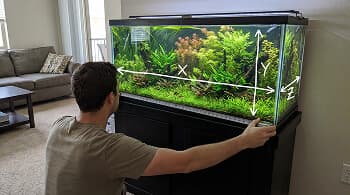
How to Measure Your Aquarium →
Not sure how to measure your tank dimensions? We have a complete visual guide with step by step instructions.
Click to see the full measuring guide
Recommended For Your Tank
Recommended gear for this setup
~45 gal tank · 314 GPH target
Aquarium test kits
Use testing to confirm the upgraded flow is doing its job.
Water conditioners
Useful alongside bigger maintenance volumes and livestock load.
As an Amazon Associate we earn from qualifying purchases.
What's Next?
Complete your aquarium setup with these helpful calculators:
What is the Filter & Flow Calculator?
This calculator helps you determine the ideal turnover rate and GPH (Gallons Per Hour) or LPH (Liters Per Hour) for your aquarium filter. Choosing the right filter is about more than just matching the tank size on the box; it's about matching your bioload and species needs.
We provide specific recommendations based on whether you use a HOB, Canister, Internal, or Sump filter, while accounting for your stocking level to ensure your water stays clean and oxygenated.
How to Use This Calculator
- Enter your aquarium volume by dimensions or direct input
- Select your filter type (HOB, Canister, Sump, etc.)
- Choose your stocking level (Low, Medium, or High bioload)
- Get instant results for recommended GPH/LPH and target turnover rates
- Check the setup checklist for optimal filter placement and efficiency
Aquarium filtration guide: flow, media, and circulation that matches your tank
A turnover or GPH result is not a trophy number. It is a starting point for building a system that moves water where waste actually collects, gives bacteria enough surface area to work, and keeps fish comfortable instead of exhausted. Filters fail in the hobby less often because the pump was 10 percent too small and more often because flow never reached the whole tank, media clogged quietly, or the filter type was wrong for the livestock.
The right setup does three jobs at once: enough total flow for your bioload and tank shape, enough media volume for mechanical and biological processing, and a circulation pattern that breaks dead zones. Nail those and water quality stays steadier between maintenance sessions. Miss one and you can chase algae, cloudy water, or stressed fish while the label on the box still looks fine.
How to read your target flow result
Use the calculator result as the flow you want the tank to receive in real life, not as a number to match exactly on a product listing. That target only makes sense if it is tied to the water volume you are actually filtering, so confirm your working tank volume before you shop. Manufacturer ratings are usually measured under ideal conditions. Real-world flow drops with filter media, hose length, head height, outlet design, and normal buildup over time. That is why filters that look fine on paper can feel weak once the tank is actually running.
- If two filter sizes are close, the slightly larger one is often the better long-term choice.
- Do not shop by GPH alone. Look at media capacity, ease of cleaning, and real tank fit.
- Two filters can be a smart option on longer tanks or heavily stocked setups because they improve circulation and add redundancy.
Flow needs depend on the fish, not just the gallons
Tank size matters, but species matter just as much. Goldfish, messy community tanks, cichlid tanks, and many active species benefit from higher turnover and stronger waste export. Bettas, fancy goldfish, fry tanks, and long-finned fish may still need good biological filtration, but they often need gentler water movement. The goal is enough circulation to keep the tank healthy without turning the fish into permanent treadmill swimmers. When you are deciding how hard you can push bioload, pair flow planning with a conservative stocking estimate so filtration and fish count stay in the same reality.
Choosing between sponge, hang-on-back, canister, internal, and sump filters
Filter type changes how the same target flow feels in practice. Sponge filters are simple, gentle, and excellent for fry, shrimp, hospital tanks, and small systems, but they are limited in polishing power and media variety. Hang-on-back filters are convenient and popular for standard tanks. Canisters offer more media volume and cleaner presentation. Sumps provide huge flexibility and extra water volume, but they add complexity. The right choice depends on the tank's needs and the maintenance style you prefer.
- Sponge filters are reliable and gentle, especially where current must stay low.
- HOB filters are easy to access and maintain, making them strong all-around choices for many tanks.
- Canisters shine where media volume, cleaner display lines, and stronger filtration matter.
- Sumps are often best for larger or advanced systems that benefit from flexibility and added volume.
Why media volume matters as much as raw flow
Water movement alone does not solve ammonia and nitrite. A filter also needs enough internal space for mechanical media that traps debris and biological media that supports the bacteria doing the real processing work. A small, high-flow filter can polish water but still be weak on long-term waste handling if there is not enough media inside it. A larger canister or sponge-based setup may process waste better even at a lower-looking headline flow.
- Mechanical media catches debris and keeps waste from breaking down in the tank.
- Biological media provides the surface area that keeps the nitrogen cycle working.
- Chemical media is optional in many tanks and should not distract from the first two jobs.
What manufacturers do not tell you about flow ratings
Product ratings often assume clean impellers, empty or minimal media, and ideal plumbing conditions. Once the filter is installed under a stand, packed with media, and collecting debris, real output drops. That does not mean the filter is bad. It means the label number is not the same thing as long-term operating flow. This is one reason experienced aquarists often buy slightly larger than the minimum recommendation.
How to tell if your circulation pattern is wrong
Good filtration is not just a filter rating. It is how the tank behaves once water starts moving. Dead spots under hardscape, oily film on the surface, and waste collecting in the same corner all point to circulation problems. A tank can technically have enough turnover and still have poor real-world flow if the outlet and intake are fighting each other or only moving one side of the aquarium.
Fast sanity check
If waste always settles in the same place, do not assume the tank needs a much bigger filter. Repositioning the outlet, changing the return angle, or adding a small circulation pump often fixes more than replacing the whole unit.
Choose the filter you will actually maintain
A filter that is difficult to open, awkward to clean, or easy to neglect usually performs worse over time than a slightly less impressive unit that you service consistently. Flow drops as intakes clog and sponges pack up. Biological performance suffers when media is replaced too aggressively. Long-term success comes from choosing equipment you will maintain on schedule, not from buying the most impressive listing on day one.
- Clean mechanical stages before they become so clogged that flow collapses.
- Rinse biological media gently in old tank water when needed instead of replacing it by habit.
- Check impellers, intakes, and hoses regularly because small restrictions add up quickly.
Important nuance
If you keep bettas, fancy goldfish, shrimp, fry, or other weak swimmers, prioritize media capacity and gentle output. High filtration does not have to mean harsh current if the flow is spread, baffled, or distributed well.
When a powerhead or second filter makes more sense than upsizing
Sometimes the issue is not total filtration capacity but how water moves through the aquarium. Long tanks, heavily decorated tanks, and tanks with dense hardscape often benefit from a second filter or small circulation pump more than from replacing one filter with a much bigger single unit. Multiple flow sources can eliminate dead zones, spread oxygen better, and give the tank backup if one unit goes down.
Simple habit that pays off
Glance at the intake strainer when you feed. If it is buried in debris or sucked against decor, flow has already dropped before you notice it in test results.
New tanks, mature tanks, and bacterial capacity
A correctly sized filter on day one still needs time for beneficial bacteria to colonize the media. Early on, the same flow moves water but the biofilter is not yet doing its full job. That is why stocking slowly and testing ammonia and nitrite matters even when the calculator says your turnover is fine. As the tank ages, plant mass, substrate, and filter gunk change how debris behaves. A mature tank might need more mechanical cleaning or less aggressive polishing depending on how you feed and aquascape.
- Do not max out stocking the same week the filter is brand new and dry.
- After big rescapes or media swaps, expect a short period where the system behaves like it is catching up again.
- Heavily planted tanks sometimes lean more on plant uptake; messy species still need honest mechanical and biological capacity.
What to check if the water still looks or tests bad
If ammonia or nitrite show up, or the tank stays hazy with debris on the bottom, the problem is not always “buy a bigger filter.” Often it is clogged intakes, neglected mechanical media, dead flow behind rock, overfeeding, or stocking that outran the biofilter. Walk through flow path and maintenance before you upsize hardware. If tests are fine but one corner always looks dirty, you probably have a circulation problem, not a missing ten percent on the label rating.
- Weak surface movement can mean low oxygen exchange even when a filter is “rated” for the tank.
- Intake and outlet too close together can short-circuit flow and leave the far end stagnant.
- After medication, fine particles or residue can clog pads faster than a normal week.
When flow feels weak even though you bought the right size
Real output drops from head height, long hoses, dirty impellers, clogged spray bars, and packed sponges. If the filter used to feel strong and slowly got quiet, service is the first fix. If it was always weak, check whether the rating assumed minimal media and no lift, which is not how you are running it.
- Clean or replace the impeller chamber per manufacturer guidance; grinding or rattling often starts here.
- Verify hoses are not kinked and connections are tight; air leaks can hurt canister performance.
- Throttle valves wide open unless you deliberately need less flow for gentle species.
Signs the filter needs attention or replacement
Filters are wear items. Impellers wear, seals crack, and motors get noisy. If you are constantly adjusting because flow never recovers after cleaning, or if the unit runs hot or vibrates, plan a repair kit or replacement before it fails during a heat wave or right before a trip. Keeping a small spare sponge or impeller on hand for critical tanks is cheaper than an emergency scramble.
Reef and high-flow freshwater: same math, different emphasis
Reef systems often stack more equipment in the flow path and care more about turnover through rock and sump volume. High-energy planted or hillstream setups may want more linear current than a betta tank with the same gallon count. The calculator gives you a turnover band; your species and aquascape still decide whether that flow should be blunt or diffused, surface-skimming or bottom-pulling.
What a well-filtered tank looks like
A well-filtered tank has stable parameters between water changes, visible surface movement, debris that moves toward removal instead of settling forever, and fish that are not fighting the current all day. Use this calculator to set a realistic turnover target, then finish the job with the right filter type, enough media, a circulation pattern that fits the scape, and maintenance you will actually do on schedule.