Aquarium Light Calculator
What is the Aquarium Light Calculator?
This calculator suggests the right light level for your tank size. We give you a PAR range (what plants and corals actually use) and a watts-per-gallon range for LED fixtures.
Choose low, medium, or high light based on your plants or reef goals. Tank depth matters, deeper tanks need more powerful lights to reach the substrate.
How to Use This Calculator
- Enter your tank dimensions or volume.
- Select your goal: low, medium, or high light (planted or reef).
- Use the PAR and wattage ranges when shopping for LED or other lights.
- Run lights 6–10 hours per day on a timer for consistency.
How would you like to enter your tank info?
Tank dimensions
What's your tank shape?
Enter Your Tank Dimensions
Light level
Refinements
Salt and tannins absorb more light; effective PAR at depth is lower than in clear freshwater.
Pendants give higher center PAR but less even coverage; strips spread more evenly.
Need Help Measuring Your Tank?
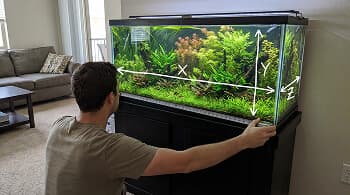
How to Measure Your Aquarium →
Not sure how to measure your tank dimensions? We have a complete visual guide with step by step instructions.
Click to see the full measuring guide
Recommended For Your Tank
Recommended gear for this setup
~45 gal tank
Aquarium test kits
Useful for checking whether plant growth changes are affecting the tank.
Water conditioners
General-purpose utility pick from the current product set.
As an Amazon Associate we earn from qualifying purchases.
What's Next?
Complete your aquarium setup with these helpful calculators:
What is the Aquarium Light Calculator?
This calculator suggests the right light level for your tank size. We give you a PAR range (what plants and corals actually use) and a watts-per-gallon range for LED fixtures.
Choose low, medium, or high light based on your plants or reef goals. Tank depth matters, deeper tanks need more powerful lights to reach the substrate.
How to Use This Calculator
- Enter your tank dimensions or volume.
- Select your goal: low, medium, or high light (planted or reef).
- Use the PAR and wattage ranges when shopping for LED or other lights.
- Run lights 6–10 hours per day on a timer for consistency.
Aquarium lighting guide: PAR, goals, and how to shop without guessing
A light recommendation is not just a wattage target. It is a match between how much usable light reaches the bottom of the tank and what you actually want to grow or display. Fish-only tanks need enough light to see the fish and enjoy the scape. Low-tech planted tanks need a modest, steady dose. High-light plants and most corals need real output at depth. Get that match wrong and you either starve photosynthetic life or drive algae and stress with light the system cannot balance.
PAR (photosynthetically active radiation) is the part of the spectrum plants and corals use for photosynthesis, roughly 400–700 nm. When this calculator talks about PAR at the substrate, it means how much of that useful light reaches the tank floor in µmol/m²/s. Depth drives how fast light falls off, so it helps to know your real water depth from a trusted volume and dimension check rather than guessing from the model name alone. Comparing fixtures by PAR at depth beats comparing box wattage alone, because two fixtures with the same wattage can put very different PAR in the same tank.
How to read your light result
Treat the PAR range and LED wattage band as a planning window, not a single magic number. Mounting height, lens type, spread, water clarity, and whether the light is premium or budget efficiency all shift what you see in the tank. If you are between two fixture sizes, leaning slightly up is often safer for deep tanks or dense scapes, as long as you are ready to control photoperiod and nutrients so algae does not take over.
- Low light: good for many easy plants, low demand, and fish-focused tanks with some greenery.
- Medium light: opens up more plant species; balance with nutrients and maintenance expectations.
- High light: demands strong discipline (CO₂ and fertilization for demanding plants; careful acclimation for corals) or algae usually follows.
Why watts per gallon stopped being enough
Watts per gallon made rough sense when everyone used similar fluorescent tubes. Modern LEDs vary wildly in efficiency and optics. A premium fixture can deliver the same PAR as a budget bar with far fewer watts. A cheap bar may need more watts and still deliver patchy coverage. Comparing fixtures by PAR at your depth (or by reputable PAR maps) beats comparing box wattage. Too much light from a strong fixture without a timer and ramp can bleach corals or fuel algae just as fast as the right PAR with a sloppy schedule.
Depth, water type, and mounting height
Light falls off with depth faster than most people expect. A tall tank needs more headroom in the recommendation than a shallow one for the same PAR at the substrate. Marine water and tinted blackwater absorb more light than clear freshwater, so effective PAR at depth can be lower than in a bright white tank. Raising a fixture several inches above the glass can cost a lot of PAR at the bottom unless the optic is designed for that height. Wide strips tend to spread light evenly; pendants and narrow beams can punch the center and leave corners dim unless you add a second source or plan the scape around the hotspot.
- Measure or estimate depth to the substrate, not just the tank height on the spec sheet.
- If you run a lid, mesh, or splash guard, factor in any extra distance from the diodes to the water.
- Expect to adjust coral placement or plant layout if the center is bright and the ends are not.
Simple habit that pays off
Run every tank on a timer. Consistent photoperiod beats eyeballing the switch. If algae shows up, shorten duration or intensity before you assume the fixture is wrong.
Photoperiod, ramping, and algae
Most tanks do well with roughly six to ten hours of full output, depending on goals and nutrient load. Starting at the shorter end and increasing slowly is safer than blasting twelve hours from day one. Sunrise and sunset ramps or manual dimming reduce shock for fish and can soften algae pressure. If you add light but not stable nutrients and CO₂ where needed, you often get algae instead of growth. Light is the gas pedal; fertilization, CO₂, and stocking are the rest of the car.
Planted tanks: match light to CO₂ and nutrients
High PAR without enough carbon and nutrients for the plant mix is a classic recipe for hair algae and frustration. Low-tech planted setups usually stay healthier when light stays in the low to medium band and plant choice stays honest. If you want carpet plants and fast growers under strong light, plan CO₂ and a fertilization strategy as part of the same budget as the fixture, not as an afterthought. Stronger light usually pairs with stable temperature, so sizing the heater for your actual volume matters as much as picking the right fixture.
Reef and marine: acclimation and spectrum
Corals need both enough PAR and a gradual ramp when upgrading lights. A big jump in intensity can bleach tissue quickly. Spectrum and spread matter for encrusting versus branching placement. This calculator helps bracket power; your livestock list and mounting still decide whether the bottom of the tank is really suitable for light-hungry species or better reserved for lower-demand placement.
Important nuance
Online PAR numbers for a fixture are usually measured in air or ideal water. Your scape, glass, film, and distance change the real value. Use guides and reviews as direction, then tune with duration and placement.
What to check if growth or color still looks wrong
If plants stretch, corals brown out, or algae explodes, the first checks are usually photoperiod, nutrient balance, and flow bringing food and waste past the tissue, not immediately buying a bigger light. If everything is pale and leaning, light may be too weak or too one-sided. If algae coats leaves while plants stall, light may be high for the available CO₂ and cleanup crew. Adjust one variable at a time so you can tell what actually changed.
- Dirty glass or a cloudy lid cuts PAR more than people notice.
- Rescapes that add tall hardscape can shade the carpet you used to have.
- Old diodes lose output over years; a tank that “used to work” may need duration bumped or hardware refreshed.
When a PAR meter is worth it
For a single low-tech community tank, you can often get by with this calculator, a timer, and observation. For multiple tanks, demanding aquascapes, or expensive corals, a PAR meter removes a lot of argument. It tells you what the bottom and midwater actually get after glass, water, and mount height, which is the only thing the biology sees.
What good lighting looks like in practice
The best lighting setup is the one that matches your goal with a stable schedule and predictable results. Fish look natural, plants grow at the rate your maintenance can support, and corals color up without weekly crises. Use this calculator to size the purchase, then finish the job with timer discipline, honest plant or coral choice, and small adjustments over a few weeks instead of one huge change on day one.