Aquarium calculators with a cleaner, smarter way to plan your setup
Get exact answers for volume, stocking, filtration, heating, substrate, and safety without bouncing between spreadsheets, forum guesses, and generic rules of thumb.
From first setup to upgrades and troubleshooting.
Carry your dimensions and results across tools.
Buy the right gear and avoid avoidable mistakes.
Designed around real aquarium decisions
Toolbox
Pick the calculator for the decision in front of you
Every tool is built to answer a specific aquarium planning question quickly, with cleaner inputs and more trustworthy outputs.
It unlocks better dosing, equipment sizing, and tank-specific recommendations.
Substrate Calculator
Calculate exactly how much gravel, sand, or aquasoil you need with displacement-aware results.
Setup Cost Calculator
Estimate the real budget for freshwater, planted, marine, and reef setups before you buy.
Volume Calculator
Get exact water volume for dosing, treatments, and equipment sizing across all tank shapes.
Heater Calculator
Match heater wattage to room temperature and tank size with better safety margin.
Stocking Calculator
Plan fish capacity with bioload, adult size, and tank volume all factored in.
Filter & Flow
Dial in turnover, filter type, and flow targets for healthier and easier-to-maintain tanks.
Glass Safety
Check safety factor, panel dimensions, and bowing risk before you build or modify a tank.
Weight Calculator
Estimate total system weight from water, glass, stand, and substrate before setup day.
Light Calculator
Choose the right PAR and light intensity for planted tanks and reef builds.
Salt & Salinity
Work out salt mix amounts for reef and marine tanks with ppt and specific gravity targets.
Water Change
Calculate the water change needed to hit your nitrate target without guesswork.
Need Help Measuring Your Tank?
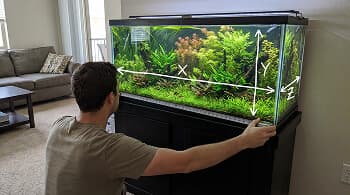
How to Measure Your Aquarium →
Not sure how to measure your tank dimensions? We have a complete visual guide with step by step instructions.
Click to see the full measuring guide
Why It Matters
Good numbers make aquarium decisions easier
Most expensive aquarium mistakes start as sizing mistakes. These are the three areas where better math pays off fastest.
Safe Medication Dosing
Underdosing won't cure sick fish. Overdosing can kill them. Precise volume measurements ensure treatments work safely and effectively.
Floor & Stand Safety
Water weighs 8.34 lbs per gallon. A 55-gallon tank can exceed 700 lbs total. Know the weight before it's too late.
Right Equipment
Size heaters, filters, and pumps correctly based on actual water volume. Save money and keep fish healthy.
Why This Site Feels Better
Built for aquarium hobbyists, not generic form-fillers
Cleaner inputs, aquarium-specific guidance, and a shared tank profile make the tools feel connected instead of isolated.
All Tank Shapes
Rectangular, bowfront, cylinder, corner tanks supported
Imperial & Metric
Switch between gallons/inches and liters/cm instantly
Free Forever
No ads, no sign-up, no hidden fees
Mobile Friendly
Calculate from your phone at the fish store
Aquarium planning guide: the numbers that matter before you buy, stock, dose, or upgrade
Most aquarium mistakes do not start with bad intentions. They start with bad assumptions. The tank says 20 gallons on the box, so you dose for 20 gallons. The filter says it fits tanks up to 40 gallons, so you assume it is enough. The fish are only an inch long at the store, so they must be fine in a small tank for now. By the time those assumptions fail, the problem usually shows up as stressed fish, algae, unstable water, wasted money, or a setup that is harder to maintain than it should be.
The point of this site is to help you get the key numbers right before those mistakes compound. If you know your real water volume, realistic stocking level, heating requirement, filter turnover, substrate depth, and total system weight, most planning decisions get much easier. You do not need to memorize formulas. You just need to know which number matters for the decision in front of you.
1. Start with real water volume, not the label on the tank
Volume is the number everything else leans on. Medication dosing, dechlorinator, salt, fertilizers, heater sizing, and even stocking decisions all get worse when the volume is wrong. The number printed on the tank is usually a best-case gross volume. Once you add substrate, hardscape, glass thickness, and realistic fill height, your actual water volume can be meaningfully lower. If you only learn one thing before setting up or treating a tank, make it this: dose and size for the water the tank really holds, not the marketing number.
2. Equal gallon tanks do not behave the same way
Two tanks can hold the same gallons and still be very different environments. A long tank gives fish more horizontal swimming room and usually better surface area for gas exchange than a tall tank. A planted tank processes waste differently from a bare grow-out setup. A reef, goldfish tank, shrimp tank, and lightly stocked community tank all place different demands on filtration, flow, maintenance, and temperature stability. That is why generic rules like "one inch per gallon" or "this filter fits up to X gallons" are often too blunt to be useful.
Good planning starts with the actual shape, livestock, and purpose of the tank. The best setup for a betta is not the best setup for rainbowfish. The right substrate for rooted plants may be the wrong one for digging cichlids. The correct heater for a warm living room may be undersized in a basement. Context matters more than canned tank-size labels.
3. Stocking is about waste, oxygen, and behavior, not just fish count
"How many fish can I keep?" sounds like a simple question, but it is really several questions stacked together. Can the tank process the waste? Is there enough oxygen exchange? Do the fish have the right kind of space? Are you planning for adult size or store size? Can your maintenance routine keep up if feeding increases or the plants melt back? A tank can look understocked to the eye and still be overloaded biologically. It can also be chemically stable and still be a bad fit because the fish do not have the right space or group size.
The safest tanks usually leave margin. They are stocked for adult fish, not temporary juveniles. They respect school size and territorial behavior. They are filtered well enough that missing one maintenance day does not turn into a chemistry problem. If you use calculators for anything on this site, stocking and volume are the pair most likely to save you from the expensive mistakes.
4. Most equipment problems are really sizing problems
A heater that barely keeps up, a filter rated for ideal conditions, a light chosen by guesswork, or a stand carrying more weight than you realized are not random aquarium problems. They are math problems that show up later as livestock stress, algae, noise, maintenance frustration, or real safety risk. Sizing equipment around the actual tank rather than the product packaging gives you margin, and margin is what makes an aquarium feel stable instead of fragile.
- Use the `Volume Calculator` first if you are not sure what your tank really holds.
- Use the `Stocking Calculator` before buying fish, not after the tank feels crowded.
- Use the `Heater Calculator` and `Filter & Flow` tools when choosing equipment, not just when troubleshooting.
- Use `Weight Calculator` and `Glass Safety` before building or placing a large system.
- Use `Substrate Calculator`, `Light Calculator`, and `Salt & Salinity` while planning the setup, not halfway through it.
5. The best aquarium tools help you make decisions in the right order
If you are setting up a tank from scratch, the smartest sequence is usually: work out the real volume, choose the layout and substrate, check total weight, size the heater and filter, then plan stocking around the finished system. If the tank already exists and something feels off, start with the simplest numbers first: real volume, nitrate trend, temperature behavior, and whether the stock list still makes sense for the system you have now. Good aquarium planning is rarely about one perfect answer. It is about getting the next decision right with the least guesswork.
That is what the homepage should help you do. Find the right calculator for the problem in front of you, get a number you can trust, and make a decision that keeps the tank healthier, safer, and easier to live with long term.